
WP5 – Laser Driven Acceleration
The objective of WP5 is to advance laser-based accelerator technologies to push the performance of modern compact accelerators, via demonstration of autonomous tuning of a µJ-class laser, prototyping of a new plasma-based beam optical element (curved capillary), and prototyping of a co-propagating, dielectric laser structure.
This work package includes five tasks.
Optoman will develop novel optical stress-compensating coatings for SiC-based fast mirrors, based on specifications from CNRS, CNR, and DESY, to enable higher stabilisation bandwidths for high-repetition rate kHz-class lasers compared to traditional silica mirrors. The coated mirrors will be deployed in CNRS, DESY, and CNR laser systems to measure performance.
Task 5.2: Precision Beam Sampler
Active laser stabilisation requires synthesising a low-energy replica of the main laser pulse. This is achieved using a beam sampler, a coated mirror that transmits a permille-level fraction of the beam while preserving its spectrum, spectral phase, and polarisation. Optoman will develop novel coatings for high-performance beam samplers, based on specifications from academic partners. Beam samplers will be tested at CNR, DESY, and CNRS high-energy laser facilities, and commercialised by Optoman after the project concludes.
The many tuneable parameters in modern accelerators make it difficult to consistently achieve high-performance working points. To address this, academic partners will develop a novel machine learning-based approach to a laser system at DESY to autonomously tune it from noise to a reproducible, optimum working point. A µJ-class ultrafast laser, suitable as a seed or pump-probe source, will serve as a demonstrator.
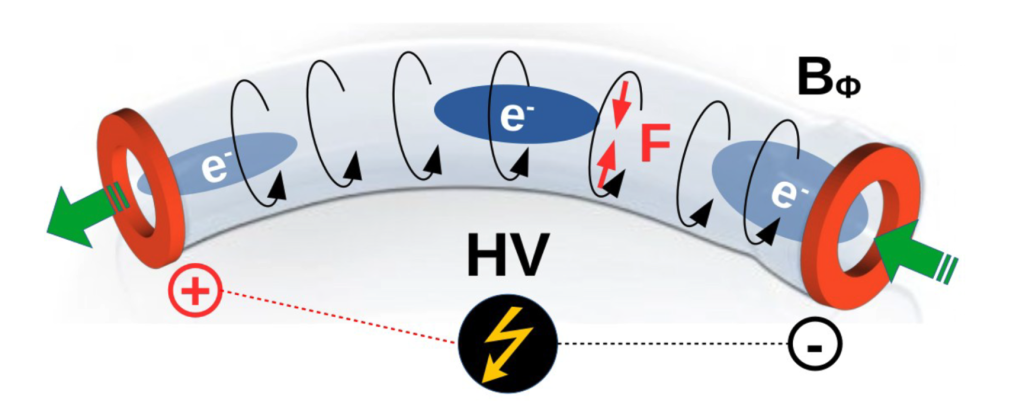
Task 5.4: Active Plasma for Bending
The strength of magnet-based beam optical elements determines the size of modern particle accelerators. A new plasma-based solution, a curved plasma capillary, will be developed to compactify beam transport for next-generation particle accelerators. INFN and CNRS will lead the mechanical realisation of the curved capillary, with INFN also developing the high-voltage discharge source to drive it. IT will realise a prototype of a novel high-resolution cavity beam position monitor whose electronics are not affected by the plasma environment.
Task 5.5: Co-Propagating Dielectric Laser Accelerator Structures
Dielectric laser accelerators (DLAs) use infrared lasers and nanostructured dielectrics for compact, high-gradient acceleration. FAU, PSI, and INFN will design co-propagating DLA structures and test them with electron beams in sub-relativistic and relativistic regimens. SENSIC will explore the use of SiC for DLA structure manufacturing. Longer wavelengths and higher accelerating gradients will be used for muon to ensure rapid acceleration.