
WP12 – Advanced Materials for Accelerators

Federico Carra
“Our work package addresses key enabling challenges for future accelerators and nuclear/fusion facilities: developing robust, radiation-resistant materials capable of operating under extreme thermal and mechanical loads.
We aim to develop, validate and scale up a new generation of radiation-resistant, high-performance materials, including carbide–carbon composites and refractory high-entropy alloys, for future beam-intercepting devices, high-power targets and related applications in medicine, energy and industry.”
WP12 aims to validate the use of Chromium-Graphite (Cr-Gr), a novel high-thermal conductivity, thermal robust, low-density composite material, under beam irradiation and demonstrate its suitability for industrial scale production through high-precision, repeatable prototypes. It will also develop advanced refractory high entropy alloys (HEAs) through additive manufacturing (AM) and field-assisted sintering technology / spark plasma sintering (FAST/SPS) for accelerator components exposed to high heat flux and irradiation.
This work package includes two tasks.
Task 12.1: Carbide-Carbon Materials with High Thermomechanical Properties
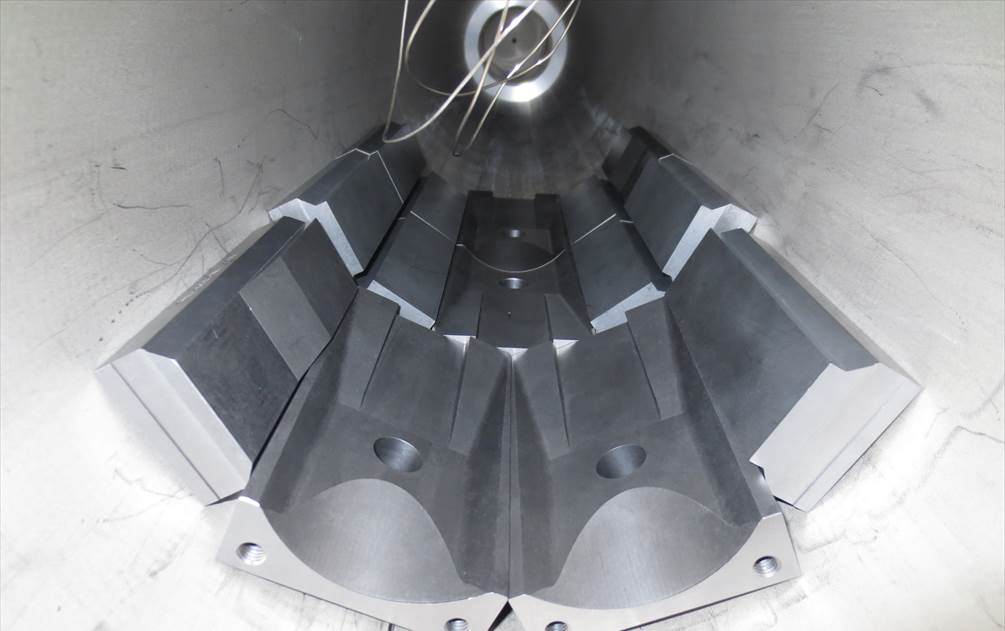
This Task focuses on the development and validation of carbide–carbon composites with high thermomechanical performance, in particular Chromium–Graphite (Cr–Gr) and related molybdenum–graphite systems. The activity targets the industrial reproducibility and scale-up of high-thermal-conductivity (≥500 W/m·K), low-density composites through the fabrication and metrological verification of functional absorber prototypes, followed by comprehensive thermophysical characterisation and irradiation testing. Beyond accelerator beam-intercepting devices, these materials offer strong industrial and medical potential thanks to their thermal shock resistance, dimensional stability and radiation robustness, making them attractive for high-heat-flux components, advanced thermal management systems, compact accelerator modules for proton therapy, and radioisotope production units. By combining advanced sintering, microstructural optimisation and irradiation validation, the task bridges frontier accelerator materials R&D with scalable manufacturing routes, fostering uptake in energy, aerospace and healthcare technologies.
Task 12.2: High-Entropy Alloys (HEAs) via Additive Manufacturing and FAST/SPS for Radiation-Resistant Components in High-Power Accelerator Systems
This Task aims to develop advanced refractory High-Entropy Alloys (HEAs) for radiation-resistant components in high-power accelerator systems, using two complementary processing routes: Additive Manufacturing (AM) and Field-Assisted Sintering Technology / Spark Plasma Sintering (FAST/SPS). The project focuses on W-based and multi-principal-element alloys tailored for extreme heat flux and irradiation conditions, targeting beam-intercepting devices such as collimators, beam windows and high-power targets. Beyond accelerator applications, these materials hold strong industrial and medical relevance, enabling longer-lasting components for compact accelerators in proton therapy, isotope production systems, and high-temperature energy technologies, while also offering cross-sector potential in fusion and aerospace environments.