
How EPITA supports the updated European Strategy for Particle Physics
The Strategy’s recommendations on accelerator R&D, industry and EU collaboration, and supporting talent match closely with EPITA’s goals
By Thomas Brent
The European Strategy for Particle Physics (ESPP) has recently been updated by CERN Council, and its recommendations on accelerator R&D, ties with industry and the EU, and supporting future talent align closely with the goals of the EPITA project.
The latest update to the Strategy was agreed on May 22 this year and sets out a broad range of topics and goals relating to research in high-energy physics in Europe and beyond. For accelerator science and technology, the Strategy makes specific recommendations, labelled as B, C, and D:
B. In order to realise the visionary plan presented, the highest priority must be the development and industrialisation of key technologies: advanced superconducting and normal-conducting RF structures, efficient RF power sources and accelerator-quality magnets in the 14–20 T range, including those based on high-temperature superconductors.
C. Demonstration of high-current multi-turn energy recovery in linacs constitutes an important step towards power-efficient lepton accelerators for a broad range of applications and should be pursued.
D. The longer-term development of advanced technologies, such as high-gradient wakefield acceleration and those underpinning bright muon beams, should be supported at an appropriate level. Synergies with the US initiative on muon collider R&D should be exploited.’
EPITA is directly addressing many of these technological advancements. EPITA is broken down into three thematic areas: accelerating systems, magnets and beamlines, and frontier technologies. Within these areas are nine work packages (WPs) driving the technological aspects of the project.
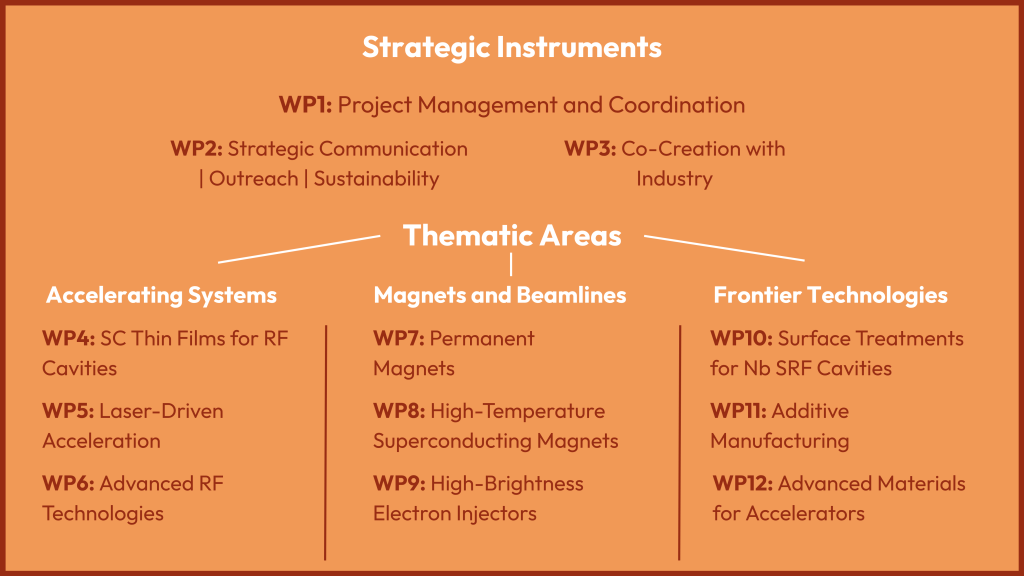
WPs 4, 6, 10, 11 and 12 all directly address recommendation B (advanced RF structures and efficient power sources); WPs 4, 6 and 10 also address recommendation C (energy-recovery linacs); WP5 directly addresses recommendation D (high gradient wakefield acceleration).
The European Large Laboratories Directors’ Group (LDG) Accelerator R&D Roadmap is also being updated to reflect the priority areas outlined in the 2026 ESPP Update.
Collaborations and talent
EPITA also aligns closely with many of the Strategy’s non-technical recommendations.
For example, the Strategy calls for the relationship between the particle physics community and the European Commission to be strengthened. EPITA is co-funded by the Commission with a €10million contribution. The project builds on several decades of collaboration with the Commission and other EU partners.
Elsewhere, the Strategy states that the unique ecosystem of particle physics research centres and universities in Europe should be further strengthened, and that partnerships with international and industry partners must continue to be supported to “ensure that Europe remains at the forefront of technologies for particle physics”.
EPITA has 42 international project beneficiaries including 16 deep-tech partners. There is also a work package specifically dedicated to the sustainability of accelerators, another recommendation of the Strategy.
Finally, the updated Strategy recommends furthering support to train the next generation of accelerator scientists and engineers, including supporting students at master and doctoral levels. EPITA will host a series of challenged-based innovation (CBI) events. These CBIs invite students for a ten-day-long programme that results in them pitching innovative new uses for accelerators in a specifically chosen topic area. The goal of the CBIs is to open up the world of particle accelerators to a young generation of talented students.